
Learn
How the Grateful Estimate Works
Every coin card in the Reference Guide and in My Vault carries a Grateful Estimate: an estimated true value for that coin at a particular grading service and grade. It is not a price guide number and it is not an appraisal. It is what the market is asking right now, worked down to what a collector would actually pay another collector. This page shows every step.
Where the numbers come from
Grateful Metals searches eBay's current Buy It Now listings for each coin in the Reference Guide — the year, mint mark, series and variety — using eBay's own Browse API. Listings are not auctions in progress; they are prices sellers have set and are waiting to receive. We treat each one as the full retail value the seller believes the coin is worth.
Each matching listing is read for its grading service and grade — PCGS, NGC, ANACS, ICG, CAC, or raw — and the listings are grouped by service and grade. A PCGS MS64 and an NGC MS64 are estimated separately; a raw VF20 is its own group. That is why the estimate on a vault coin matches the service and grade you recorded, not a blended figure.
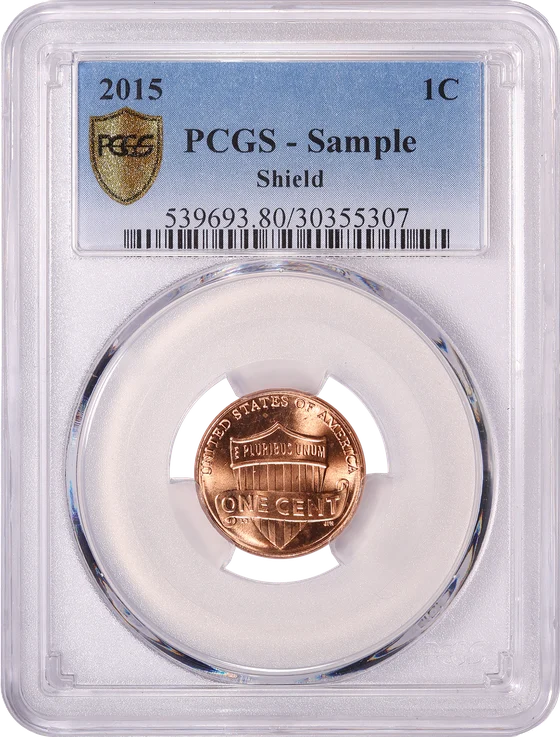
Reading a graded holder. The label names the grading service and grade, the year, denomination and coin type, and carries a certification barcode. That service and grade are what the estimate matches on, which is why a PCGS MS64 and an NGC MS64 are estimated separately.
Photo: sample holder from the PCGS media kit, used to show what a graded holder looks like. PCGS does not endorse Grateful Metals or the Grateful Estimate.
What gets left out
- Lots, rolls, tubes, sets, replicas, copies, jewelry and "holder only" listings.
- Listings whose title does not name the coin's exact year and mint mark, so an 1882-S cannot borrow an 1882-O's price.
- Listings with no readable grade ("Uncirculated", "PCGS Genuine") — there is nothing to match them to.
- Proof listings for business strikes and the reverse.
- CAC-stickered coins when plain ones exist for the same service and grade — the sticker carries its own premium.
- With four or more listings, any ask below half the median. A $40 "1893-S Morgan" among $3,000 asks is not a bargain, it is a mistake or a fake.
The Grateful Estimate Generator
The surviving listings for one service and grade go into the Generator, which applies these steps in order. Each step removes one thing that an asking price contains and a true value does not.
1. Landed ask and retail anchor
Each listing's landed ask is its price plus shipping. With four or more listings the retail anchor is the 25%-percentile landed ask — the price the cheapest quarter of sellers agree on. With fewer, it is the lowest landed ask. One stubborn seller at $500 cannot drag a well-populated grade around, and one lonely bargain cannot define it either.
2. Negotiation
Multiply by 0.93, less 0.05 for every listing that accepts Best Offers (so 0.88 when all of them do). Sellers who take offers typically auto-accept around 85–92% of their list price; fixed-price sellers still run sales and coupons.
3. Marketplace
Multiply by 0.92. eBay's final-value fee (about 13% in coin categories) is priced into asks. A value that passes between two collectors — the kind The Bourse is built for — does not carry it.
4. Evidence
Multiply by 0.95 when only one listing exists, 0.97 with two or three, and 1.00 with four or more. If the asks are widely scattered (the 75th percentile is more than 2× the 25th), a further 0.97 applies. A single asking price is weak evidence of value; a dozen that agree is strong evidence.
5. Metal floor
For coins with gold, silver, platinum or palladium content, the estimate is never below the coin's melt value at today's spot price. If the retail anchor itself sits within 15% of melt, the coin is trading as bullion, and bullion spreads are 2–5%, not 15–40%, so steps 2–4 are replaced by a single 0.97 factor.
Grateful Estimate = max( melt value, retail anchor × negotiation × marketplace × evidence )
bullion-like: Grateful Estimate = max( melt value, retail anchor × 0.97 )
In practice a single fixed-price listing lands at about 81% of its asking price; four or more agreeing fixed-price sellers at about 86%; four or more sellers who all take offers at about 81%. Every card's tooltip and every coin page shows the anchor, the multiplier and the confidence (low, medium or high) so you can see the working.
What the estimate is, and is not
- It is an estimated fair value between collectors — roughly what a knowledgeable buyer would pay today. It sits below retail asking prices and above what a dealer would offer to buy.
- For a coin in your vault with nothing listed at its own grade, a nearby grade of the same coin stands in, and the label says so. The closest grade within the same band is marked near (for example “near XF45”); it never crosses from circulated to uncirculated or between proof and business strikes. If nothing is that close, a lower grade sets a minimum, marked at least, because a coin is worth at least a lower grade of itself. Either way the confidence is low.
- It is N/A when no current listing matches the coin at any grade, when the coin has not been scanned yet, or when its last scan is older than 180 days. We would rather show nothing than something stale.
- It is only as good as the listings behind it. Scarce coins with one or two listings get a low-confidence estimate; common coins with dozens get a high-confidence one.
- It is informational. It is not an appraisal, a guarantee, or an offer, and it is not financial advice.
Listing data comes from eBay; each estimate links to the listing it was anchored on. Spot prices for the metal floor come from the same source as the Melt values across the app.